Need help with sign-in, payments or tests?Call +91 959564773410:00 am to 6:00 pm IST
BHARAT ELECTRONICS LIMITED · RECRUITMENT 2026Probationary Engineer · 350 vacancies
BEL RECRUITMENT · E-II GRADE

Bharat Electronics Limited Probationary Engineer 2026: Mock Tests & Previous Papers

Prepare for the Electronics and Mechanical Probationary Engineer posts with free previous papers and full-length mock tests.

Total vacancies
350
Electronics
200
Mechanical
150

Applications close 18 November 2026
Tentative CBT: 22 December 2026 · View recruitment details

3 free papers per branch No signup to start Retakes included
THE OPPORTUNITY2026 / E-II GRADE
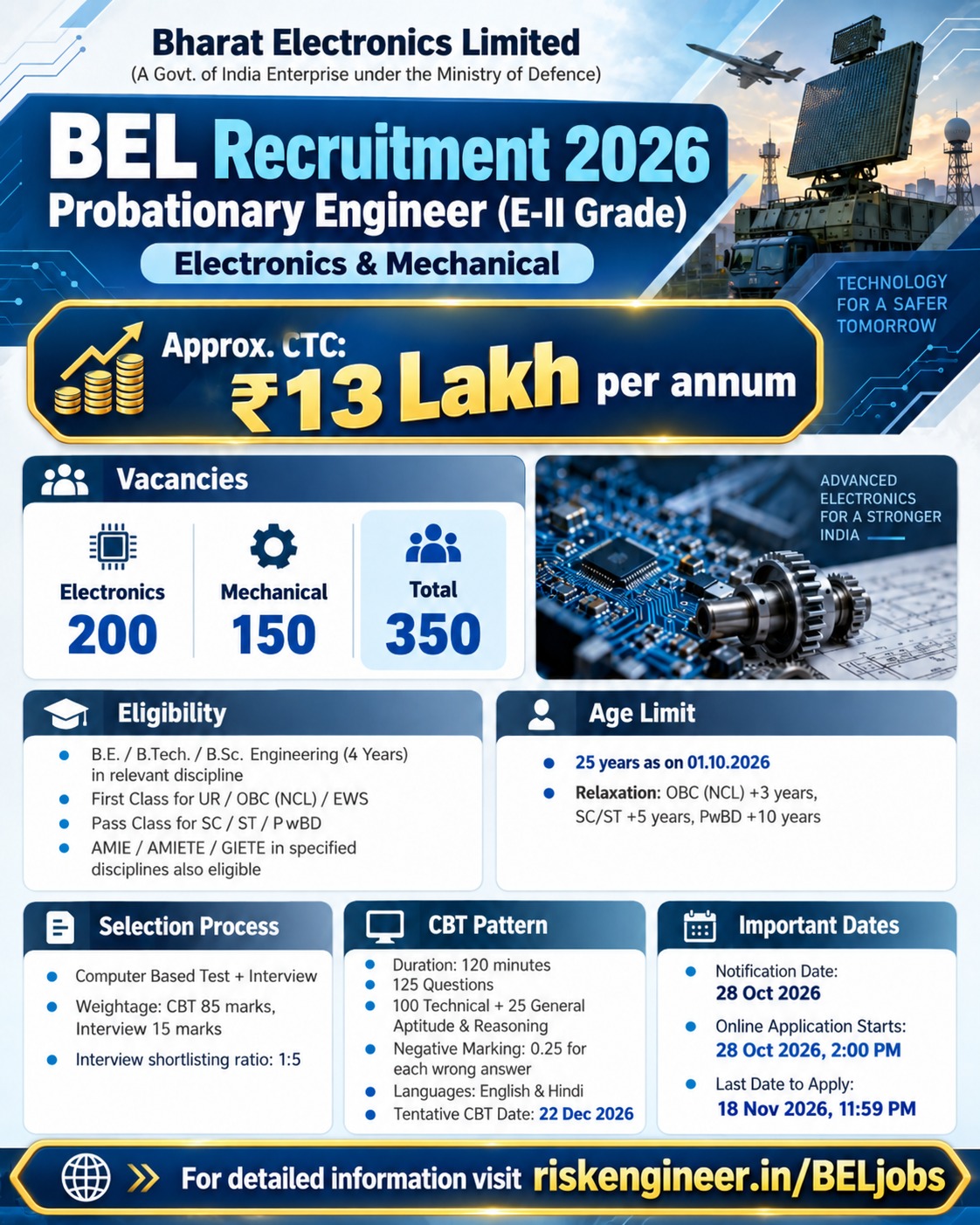
BEL recruitment 2026 overview: Electronics and Mechanical Probationary Engineers, 350 vacancies, approximate CTC ₹13 lakh per year

Recruitment overview · Check the official notification for current details.

125questions per test
120 minto practise under pressure
+1 / −0.25exam-style marking
FREEall six previous papers
SIX PAPERS. FREE FOR EVERYONE.

Free BEL previous year papers.

No signup to attempt a paper.
Sign in for free question-by-question review.

3 FREE PREVIOUS PAPERS

Electronics

Circuits, signals, devices and communication. Practise the papers that put your fundamentals to work.

125 questions · 120 minutes each · Unlimited retakes. May 2025 uses an unofficial key. Detailed explanations coming soon.

3 FREE PREVIOUS PAPERS

Mechanical

Mechanics, thermal sciences, design and manufacturing. Turn your preparation into exam-day confidence.

125 questions · 120 minutes each · Unlimited retakes. May 2025 uses an unofficial key. Detailed explanations coming soon.

PREPARE BY BRANCH

Find your BEL exam guide.

Syllabus topics, previous papers and a revision plan for your branch.

ORIGINAL MOCKS FOR YOUR BRANCH

5 mocks. Your next step.

Separate mock-test series for each branch.
Mocks 1–3 are live in both branches.

5 MOCK TESTS · MOCKS 1–3 LIVE

Electronics

₹499per branch package
inclusive of all taxes
  • 5 mock tests for Electronics
  • Separate from the free previous papers
  • Valid until September 30, 2027

Mocks 1, 2 and 3 available now; later mocks follow the release schedule after upload.

5 MOCK TESTS · MOCKS 1–3 LIVE

Mechanical

₹499per branch package
inclusive of all taxes
  • 5 mock tests for Mechanical
  • Separate from the free previous papers
  • Valid until September 30, 2027

Mocks 1, 2 and 3 available now; later mocks follow the release schedule after upload.

Each purchase unlocks only its selected branch. The Risk Engineer package is separate. All six previous papers remain free.

ORIGINAL MOCK SERIES

A new mock every two days.

5 mocks per branch / ₹499 per branch package.
Sign-in and branch access required. Mocks 1–3 are live in both branches.

Electronics

Dates show the planned schedule for upcoming mocks. Original mocks require sign-in and the matching branch package.

Mechanical

Dates show the planned schedule for upcoming mocks. Original mocks require sign-in and the matching branch package.

MAKE EVERY ATTEMPT COUNT

From practice to a plan.

01

Choose your paper

Pick any of the six previous papers and start for free, without signup.

02

Find your exam rhythm

Work against the clock, move between sections and flag questions to revisit.

03

Know what to work on

See your score immediately. Sign in for free to review each answer and learn from mistakes.

THE EXAM, AT A GLANCE AND IN DEPTH

A good plan starts here.

Last updated
Based on the supplied 2026 advertisement.

BEL Probationary Engineer · E-II grade

200 Electronics + 150 Mechanical vacancies

Applications close: 18 November 2026 · Tentative CBT: 22 December 2026

BEL Probationary Engineer 2026 notification: dates and vacancies

BEL released the notification for Probationary Engineer recruitment on 28 October 2026 (advertisement No. 17556/HR/All-India/2026). The posts are in the Production and Support Services departments of BEL's units.

Important dates

EventDate
Notification released28 October 2026
Online application opens28 October 2026, 2:00 PM
Last date to apply and pay the fee18 November 2026, 11:59 PM
Date for calculating age1 October 2026
Computer-based test (CBT)22 December 2026 (tentative)
Call letterTo be downloaded from BEL's website; it is not sent by email or post

BEL may change the CBT date. Any change, corrigendum or extension is posted in the Careers section of bel-india.in.

Vacancies

PostTotalUREWSOBC (NCL)SCST
Probationary Engineer (Electronics)2008120543015
Probationary Engineer (Mechanical)1506215402211
Total35014335945226

PwBD vacancies (as per Government guidelines, including backlog):

PostCurrentBacklogTotalBy sub-category (A / B / C / D / E)
Electronics720278 / 8 / 3 / 4 / 4
Mechanical612185 / 5 / 2 / 3 / 3

BEL may increase or decrease the number of posts in each branch depending on its requirement at the time of recruitment.

Place of posting: BEL units at Bangalore (Karnataka), Ghaziabad (Uttar Pradesh), Pune, Nagpur and Navi Mumbai (Maharashtra), Hyderabad and Ibrahimpatnam (Telangana), Chennai (Tamil Nadu), Palasamudram, Nimmaluru and Machilipatnam (Andhra Pradesh), Panchkula (Haryana) and Kotdwara (Uttarakhand). Selected candidates can be posted anywhere in India.

Eligibility: qualification and age limit

Educational qualification

Electronics: B.E / B.Tech / B.Sc (4-year) Engineering in Electronics, Electronics and Communication, Electronics and Telecommunication, Communication, or Telecommunication.

Mechanical: B.E / B.Tech / B.Sc (4-year) Engineering in Mechanical.

CategoryMinimum class required
UR, EWS, OBC (NCL)First class
SC, ST, PwBDPass class
  • The degree must be from an AICTE-approved college.
  • AMIE, AMIETE or GIETE (first class) in the same disciplines is also accepted.
  • Other equivalent disciplines and dual specialisations are not accepted.
  • The specialisation on your degree certificate must match the branch you apply for, or you won't be considered for the interview.
  • If your university awards grades (CGPA, GPI, SGPA), you must bring its official percentage conversion certificate or formula to the interview. Not producing it leads to disqualification.

Age limit (as on 1 October 2026)

CategoryUpper age limit
UR / EWS25 years
OBC (NCL)28 years (3 years' relaxation)
SC / ST30 years (5 years' relaxation)
PwBD (UR / EWS)35 years (10 years' relaxation)
PwBD + OBC (NCL)38 years (13 years' relaxation)
PwBD + SC / ST40 years (15 years' relaxation)
Ex-Servicemen5 years' relaxation, as per Government guidelines

Proof of age is your Matriculation or Higher Secondary certificate. A birth certificate is accepted only if your school certificate doesn't show your date of birth.

Other conditions

  • Only Indian nationals can apply.
  • You must be found medically fit by BEL's medical authorities. Candidates with colour blindness are not suitable for either branch.
  • Category certificates must meet BEL's conditions. EWS: income for FY 2025-26, issued on or after 1 April 2026. OBC (NCL): caste in the Central List, certificate issued on or after 1 October 2025 in the latest central-government format. SC/ST: latest Government of India format. PwBD: at least 40% disability, latest format.
  • If you work in a government department, PSU or autonomous body, bring a No Objection Certificate from your employer to the interview.

Salary and benefits

ItemDetails
GradeE-II
Basic pay scale₹40,000 – 3% – ₹1,40,000 (due for revision from 1 January 2027)
CTCAbout ₹13 lakh a year
AllowancesDA, HRA, conveyance allowance, performance-related pay, medical reimbursement and other benefits as admissible

Training and service bond: selected candidates do 6 months of orientation and on-the-job training. They sign a service agreement to work for BEL for 2 years; the amount payable for breaking it is ₹2,00,000.

Application fee

CategoryFee
General (UR), OBC (NCL)₹1,180 (₹1,000 + GST)
SC, ST, PwBD, Ex-ServicemenNo fee
EWSSee the note below

The fee is paid online through the SBI e-Pay Lite gateway (debit or credit card, net banking, wallet or UPI) and is not refundable.

Note for EWS candidates: the advertisement is inconsistent. Its fee section and FAQs say EWS candidates must pay ₹1,180, but the online application instructions list EWS among the exempted categories. Check what the application portal asks for, or confirm with BEL's helpdesk (9152028159, Monday to Friday, 10 AM to 5 PM).

Selection process

  • Computer-based test (CBT). All candidates whose applications are accepted are provisionally called for the CBT.
  • Interview. Candidates are shortlisted for interview in the ratio 1:5, discipline-wise and category-wise, based on CBT marks. The shortlist is published on BEL's website.
  • Final selection is based on both stages: CBT 85 marks, interview 15 marks.

Minimum qualifying marks: 35% for General, OBC and EWS candidates, and 30% for SC, ST and PwBD candidates, in the CBT and in the interview separately. In practice the CBT marks needed for an interview call are far higher than this minimum; see the 2025 cut-offs below.

Outstation candidates called for interview get AC Chair Car or III-tier AC train fare both ways by the shortest route. There is no travel reimbursement for the CBT.

Exam pattern and marking scheme

ItemDetails
ModeComputer-based test (CBT)
Duration120 minutes
Questions125 multiple-choice questions
Sections100 Technical (your branch) + 25 General Aptitude and Reasoning
Marks1 mark per question; 125 in total
Negative marking−0.25 for each wrong answer
Unattempted / marked for review0 marks
LanguageEnglish and Hindi (the English version is final if they differ)
Time per questionAbout 58 seconds on average

What the previous papers looked like. In all three recent papers (December 2023, May 2025 and December 2025), the 25 non-technical questions were split into 12 General Aptitude and 13 Reasoning questions, and each question had four options. The 2026 notice gives only the combined total of 25, so the split could change.

Is guessing worth it? With four options and −0.25 for a wrong answer, a blind guess gains about +0.06 marks on average, and ruling out one option first raises that to about +0.17. These are averages over many questions, not a guarantee, and every guess uses time you could spend on a question you can actually solve. A blank answer scores 0.

A caution on "marked for review": BEL's notice says no marks are given for unattempted or marked-for-review questions. In the real exam, clear the review mark on any answer you want counted.

Syllabus overview

> Please note: this is not the official syllabus. BEL does not publish a detailed syllabus for the Probationary Engineer exam. The syllabus below has been prepared by riskengineer.in from the three previous BEL PE papers of each branch (December 2023, May 2025 and December 2025) and the standard B.E./B.Tech curriculum of each branch. Topics that were not asked in those papers can still be asked in 2026.

What BEL says about the syllabus

According to the 2026 notice, the CBT will mainly have objective questions from the core engineering subjects of your branch, plus a section on General Aptitude that tests analytical and reasoning ability. BEL advises candidates to prepare thoroughly from the curriculum of their engineering degree.

How to read the syllabus below

  • ★ marks a topic that was asked in at least one of the three previous papers. Topics without ★ were not asked in those papers but are standard parts of the subject, so they are fair game.
  • The question counts show how many questions each subject carried in the three papers together (300 technical questions). Three papers are a small sample: read the counts as rough priorities, not as a forecast for 2026.
  • Each technical question is counted once, under the subject it fits best.

Electronics syllabus

Subject-wise questions in the three previous Electronics papers

SubjectDec 2023May 2025Dec 2025Total (of 300)
Analog Circuits16151243
Electronic Devices9151438
Control Systems10151035
Digital Circuits1291334
Networks and Circuit Theory1061228
Digital Communication and Information Theory99624
Electromagnetic Fields and Waves441018
Signals and Systems56617
Analog Communication64616
Digital Signal Processing53715
Transmission Lines, Waveguides and Antennas55313
Satellite and Wireless Communication6208
Microprocessors and Microcontrollers3317
Radar and Optical-Fibre Communication0303
Electronic Measurements and Instrumentation0101
Engineering Mathematics (no direct questions)0000

What stands out

  • Circuits and devices (Networks, Electronic Devices and Analog Circuits) made up about a third of the technical section in every paper: 35, 36 and 38 of 100 questions.
  • Control Systems carried at least 10 questions in every paper (10, 15 and 10).
  • The question style changed a lot. May 2025 was almost entirely one-line conceptual questions, while December 2025 had about 38 numerical questions and 13 "which statements are correct" questions. Prepare for both.
  • Engineering Mathematics had no direct question, but phasors, transforms, vector calculus and probability run through the numericals.

Detailed Electronics syllabus

Networks and Circuit Theory

28 questions in the three papers (Dec 2023: 10, May 2025: 6, Dec 2025: 12)

  • ★ Basic network analysis: KCL, KVL, nodal and mesh analysis, source transformation, star–delta conversion, dependent sources, equivalent resistance of resistive networks.
  • ★ Network theorems: Superposition, Thevenin, Norton (including circuits with dependent sources), maximum power transfer, reciprocity, Millman.
  • ★ Sinusoidal steady state: Phasors, impedance and admittance, real, reactive and apparent power, power factor and its correction.
  • ★ Resonance and frequency response: Series and parallel RLC resonance, Q-factor, bandwidth and selectivity, behaviour below and above resonance, frequency-response curves of R, X_L, X_C, |Z| and |I|.
  • ★ Time-domain response of circuits: RC, RL and RLC circuits, natural and forced response, transient and steady-state response, zero-input and zero-state response, step and impulse (including delayed impulse) response, initial and final conditions, Laplace-domain circuit analysis.
  • ★ Two-port networks: Z, Y, h and ABCD parameters, conversion between parameters, reciprocity and symmetry, terminated and short-circuited ports, interconnection of two-ports.
  • ★ Magnetically coupled circuits: Self and mutual inductance, coefficient of coupling, turns ratio, dot convention, ideal transformer.
  • Network topology: Graphs, trees, incidence, tie-set and cut-set matrices.

Practice focus: Pick the quickest method for each circuit (nodal, mesh, Thevenin or Norton), convert between two-port parameter sets, and sketch how each element's impedance varies with frequency.

Electronic Devices

38 questions in the three papers (Dec 2023: 9, May 2025: 15, Dec 2025: 14)

  • ★ Semiconductor physics: Energy bands, intrinsic and extrinsic semiconductors, carrier concentration and mass-action law, Fermi level and its movement with doping, charge neutrality, behaviour at 0 K and with temperature, mobility, drift and diffusion, generation and recombination.
  • ★ PN junction: Depletion region, transition (junction) and diffusion capacitance, I–V characteristics, breakdown mechanisms.
  • ★ Diode models and special diodes: Ideal, practical, piecewise-linear and small-signal diode models, Zener diode (characteristics, uses and small-signal model), varactor, tunnel and Schottky diodes.
  • ★ Optoelectronic devices: LED (emission wavelength from frequency or band gap, internal and external quantum efficiency), photodiodes (PN, PIN and avalanche: structure and doping profile), photodiode parameters (responsivity, quantum efficiency, bandwidth, dark current, shunt resistance), phototransistor, solar cell, laser diode.
  • ★ Bipolar junction transistor: Operating regions, CB/CE/CC configurations, current gains α, β and γ, Early effect.
  • ★ MOS capacitor and field-effect transistors: Accumulation, depletion and inversion regions, threshold voltage, oxide capacitance, C–V characteristics, MOSFET I–V characteristics, body effect, JFET basics.
  • ★ IC fabrication basics: Epitaxy, oxidation (wet and dry, and when each is used), diffusion, ion implantation, annealing, photolithography and etching, CMOS process flows (n-well, p-well and twin-tub) and the order of their steps.

Practice focus: Work numerical problems on carrier concentration, Fermi level and junction capacitance, and be able to explain how each device's characteristic changes with bias, doping and temperature.

Analog Circuits

43 questions in the three papers (Dec 2023: 16, May 2025: 15, Dec 2025: 12)

  • ★ Diode circuits: Half and full-wave rectifiers, ripple and capacitor filters, clippers (series and parallel, two-way), clampers (positive and negative), voltage regulators.
  • ★ Transistor biasing: Fixed, collector-feedback, emitter and voltage-divider bias for BJTs, FET/MOSFET biasing (including self-bias), Q-point, bias stability.
  • ★ Small-signal amplifiers: h-parameter and hybrid-π models, transconductance, CE/CB/CC voltage and current gain, input and output resistance, effect of load and source resistance.
  • ★ Multistage amplifiers and frequency response: RC, transformer and direct coupling, cascade and cascode stages, low and high-frequency response and what limits the bandwidth at each end, gain-bandwidth and unity-gain bandwidth.
  • ★ Feedback amplifiers and oscillators: Feedback topologies and their effect on gain, Barkhausen criterion and the conditions for sustained oscillation, RC, LC (Colpitts, Hartley) and crystal oscillators, ring oscillators, voltage-controlled oscillators, relaxation oscillators (including UJT).
  • ★ Op-amps and applications: Ideal and practical op-amp parameters, inverting and non-inverting amplifiers, unity-gain buffer, differential and instrumentation amplifiers, summer, integrator, differentiator, log and antilog amplifiers, comparators, Schmitt trigger.
  • ★ Active filters: First and second-order low-pass, high-pass and band-pass filters, cut-off frequency, gain at cut-off, active versus passive filters.
  • ★ Power amplifiers and timers: Class A, B, AB and C amplifiers, efficiency, 555 timer in astable, monostable and bistable modes (timing formulas, trigger and reset).

Practice focus: Draw the small-signal equivalent before calculating any gain, trace clipper and clamper outputs for a given input waveform, and know the gain formula of each standard op-amp circuit.

Digital Circuits

34 questions in the three papers (Dec 2023: 12, May 2025: 9, Dec 2025: 13)

  • ★ Number systems and arithmetic: Binary, octal, hexadecimal, BCD and other codes, signed numbers and complements, binary addition and multiplication, word length of results.
  • ★ Boolean algebra and minimisation: Boolean theorems, canonical SOP and POS forms, minterms and maxterms, Karnaugh maps.
  • ★ Combinational circuits: Adders, subtractors, multiplexers, decoders, encoders, comparators, code converters (binary, Gray, BCD, excess-3).
  • ★ Sequential circuits: Latches (SR, D, T and gated latches), flip-flops, synchronous and asynchronous counters, ring and Johnson counters, shift registers, timing (setup and hold time), hazards.
  • ★ Finite state machines: Mealy and Moore machines, state diagrams and tables, sequence detectors, controller design.
  • ★ Logic families and CMOS logic: TTL (output stage, switching current, fan-out), CMOS inverter (operation, switching behaviour, transistor sizing), comparison of RTL, TTL, ECL and CMOS, static and dynamic power, noise margin, propagation delay.
  • ★ Programmable logic devices: PAL, PLA, CPLD and FPGA architectures, FPGA logic blocks and their operating modes.
  • ★ Data converters: ADC and DAC types, sample and hold, resolution, quantisation error, conversion time, digital output code.
  • ★ Semiconductor memories: ROM, PROM, EPROM, EEPROM and flash, SRAM and DRAM, their cell structures, and how they compare in speed, density and cost.

Practice focus: Minimise functions with Karnaugh maps against the clock, trace counters and state machines one clock edge at a time, and practise data-converter resolution and output-code calculations.

Microprocessors and Microcontrollers

7 questions in the three papers (Dec 2023: 3, May 2025: 3, Dec 2025: 1)

  • ★ 8085 architecture: Registers, flags, buses, pin functions, instruction, machine, fetch and execute cycles, T-states and instruction timing.
  • ★ 8085 addressing modes and instruction set: Immediate, register, direct, register-indirect and implied addressing; data transfer, arithmetic, logic and branch instructions.
  • ★ Programming and interfacing: Assembly programming, stack and subroutines, hardware and software interrupts (including RST), memory-mapped and I/O-mapped I/O, peripheral interface chips (parallel I/O, timer/counter, interrupt controller, keyboard and display controller, DMA controller) and their Intel part numbers.
  • ★ 8086 and microcontrollers: 8086 architecture basics; 8051 timers, serial communication and interrupts; microcontroller reset sources and supervisory features (power-on, watchdog, brown-out and external reset).
  • Computer organisation basics: ALU and datapath, memory hierarchy, input–output organisation.

Practice focus: Know each common 8085 instruction's addressing mode, size, T-states and effect on the flags, convert T-states into execution time for a given clock, trace short assembly programs by hand, and know what each common peripheral chip and microcontroller reset source does.

Signals and Systems (continuous-time)

17 questions in the three papers (Dec 2023: 5, May 2025: 6, Dec 2025: 6)

  • ★ Signals and system properties: Classification of signals (energy and power, periodic, even and odd), causality, stability, linearity, time-invariance, memory, impulse and step response, convolution, series and parallel interconnection of systems.
  • ★ Fourier series and Fourier transform: Fourier series (trigonometric and exponential forms), Fourier transform properties, standard transform pairs (impulse, step, exponential, rectangular and triangular pulses), spectrum, bandwidth and main-lobe width, distortionless transmission and group delay.
  • ★ Laplace transform: Properties (time and s-domain shifting, integration, differentiation), ROC, inverse transform, transfer functions.
  • ★ Sampling: Nyquist rate, aliasing, anti-aliasing filters, reconstruction.

Practice focus: Test a system for linearity, time-invariance, causality and stability from its equation or impulse response, and use transform properties and standard pairs instead of integrating from scratch.

Digital Signal Processing

15 questions in the three papers (Dec 2023: 5, May 2025: 3, Dec 2025: 7)

  • ★ Discrete-time signals and systems: Discrete-time convolution (including the length of a linear convolution), difference equations, DTFT.
  • ★ Z-transform: Properties (linearity), ROC, inverse transform, pole-zero plots, causality and stability from the ROC.
  • ★ DFT and FFT: DFT properties, frequency resolution, zero-padding, spectral leakage and windowing, circular vs linear convolution, FFT and inverse FFT.
  • ★ Multirate processing: Decimation and interpolation, upsampling and downsampling, sampling-rate conversion.
  • ★ Digital filter design: FIR filters (linear phase, the window method and the common windows: rectangular, Bartlett, Hanning, Hamming, Blackman and Kaiser, equiripple design), IIR filters (bilinear transform with prewarping, impulse invariance), stability.
  • Filter structures and finite word length: Direct, cascade and parallel structures, coefficient quantisation effects.

Practice focus: Read causality and stability from a z-transform's region of convergence, compute short DFTs and convolutions by hand, and compare the standard FIR and IIR design methods.

Control Systems

35 questions in the three papers (Dec 2023: 10, May 2025: 15, Dec 2025: 10)

  • ★ Transfer functions: Open and closed-loop systems, effect of feedback on gain and sensitivity, poles and zeros, order and type of a system, models of electrical and mechanical (translational and rotational) systems and their analogies.
  • ★ Block diagrams and signal-flow graphs: Block-diagram reduction, summing and take-off points, disturbance inputs, Mason's gain formula (forward paths and loops), relation between block diagrams and SFGs.
  • ★ Time response: First and second-order systems, delay, rise, peak and settling time, overshoot, effect of added poles and zeros, steady-state error and error constants.
  • ★ Stability: Routh–Hurwitz criterion (necessary conditions, range of gain for stability), relative stability.
  • ★ Controllers: P, I, D, PI, PD and PID control actions and their effects on the time response.
  • ★ Root locus: Construction rules, number of branches and where they start and end, angles of departure and arrival.
  • ★ Frequency response and compensation: Bode and Nyquist plots, Nyquist stability criterion, gain and phase crossover frequencies, gain and phase margins, lead, lag and lead-lag compensators.
  • ★ State-space analysis: State equations, choice and number of state variables, transfer function from state space, controllability, observability.

Practice focus: Reduce block diagrams and signal-flow graphs quickly, apply the Routh test, and relate pole and zero positions to the time-response measures.

Analog Communication

16 questions in the three papers (Dec 2023: 6, May 2025: 4, Dec 2025: 6)

  • ★ Amplitude modulation: AM, DSB-SC, SSB and VSB, modulation index, sideband power, envelope and coherent (synchronous) detection, effect of local-oscillator phase error.
  • ★ Angle modulation: FM and PM, narrowband and wideband FM, modulation index, frequency deviation, Carson's bandwidth rule, FM detection.
  • ★ Radio receivers: Superheterodyne receiver and its stages (RF amplifier, mixer and local oscillator, IF amplifier, detector), intermediate frequency (standard values for AM and FM), image frequency, selectivity and sensitivity.
  • ★ Bandpass signal representation: Complex envelope, Hilbert transform, pre-envelope.
  • Multiplexing: Frequency-division and time-division multiplexing.

Practice focus: Calculate modulation index, power and bandwidth for AM and FM, and work through superheterodyne frequency questions (local-oscillator, intermediate and image frequencies).

Digital Communication and Information Theory

24 questions in the three papers (Dec 2023: 9, May 2025: 9, Dec 2025: 6)

  • ★ Random processes and noise: Stationarity (strict and wide-sense), autocorrelation, power spectral density, sources and types of noise, noise and SNR.
  • ★ Pulse modulation: Sampling, quantisation and quantisation noise, PCM (bits per sample, number of levels, bit rate), DPCM, delta modulation, line coding.
  • ★ Digital modulation: ASK, OOK, FSK, BPSK, QPSK and QAM, symbol rate, matched-filter detection, bit-error rate and its dependence on SNR, intersymbol interference and pulse shaping.
  • ★ Information theory and coding: Entropy (bits and nats), mutual information, Shannon channel capacity, error-control coding (Hamming codes and how they are constructed, check bits, syndrome decoding, CRC), basics of quantum cryptography.

Practice focus: Calculate PCM bit rates, quantisation levels, entropy and channel capacity, and know the defining properties of strict-sense and wide-sense stationary processes.

Electromagnetic Fields and Waves

18 questions in the three papers (Dec 2023: 4, May 2025: 4, Dec 2025: 10)

  • ★ Electrostatics: Coulomb's and Gauss's laws, volume charge distributions, potential and E = −∇V, capacitance, conductors in electrostatic equilibrium.
  • ★ Dielectrics and boundary conditions: Boundary conditions for E and D, refraction of field lines at a dielectric interface.
  • ★ Magnetostatics: Biot–Savart law, Ampere's circuital law, curl of H and current through a surface.
  • ★ Maxwell's equations: Integral and differential forms (Gauss's laws for electric and magnetic fields, Faraday's law, Ampère's law with displacement current), continuity across boundaries, wave equation, Poynting vector.
  • ★ Plane waves: Propagation in lossless and lossy media, good conductor vs good dielectric, skin depth, phase velocity, intrinsic impedance and E–H phase, reflection and refraction, Brewster angle, polarisation.

Practice focus: Practise plane-wave numericals (skin depth, phase velocity, intrinsic impedance, loss tangent) and boundary-condition problems, writing the units at every step.

Transmission Lines, Waveguides and Antennas

13 questions in the three papers (Dec 2023: 5, May 2025: 5, Dec 2025: 3)

  • ★ Transmission lines: Propagation constant, characteristic impedance (including coaxial lines), attenuation, reflection coefficient, standing waves and VSWR, impedance matching, Smith chart.
  • ★ Waveguides: Rectangular and circular waveguides, TE and TM modes, cut-off frequency, guide wavelength, phase and group velocity, wave impedance; TEM and hybrid modes, and which structures support each mode.
  • ★ Antennas: Horn, dipole, monopole, loop, patch and parabolic antennas, radiation pattern, gain, directivity, beamwidth, effective aperture, polarisation, radiation resistance and radiated power, broadside and end-fire arrays, far-field power density.

Practice focus: Calculate reflection coefficient, VSWR and waveguide cut-off frequencies, and recognise the common antenna types from their structure and radiation pattern.

Satellite and Wireless Communication

8 questions in the three papers (Dec 2023: 6, May 2025: 2, Dec 2025: none)

  • ★ Radio-wave propagation: Ground, sky and space waves, line-of-sight range, Fresnel zones, multipath fading and its effect on error performance (analysis, simulation and measurement of bit-error rate).
  • ★ Multiple access: FDMA, TDMA and CDMA, frame structure and guard times.
  • ★ Satellite links: Orbits (GEO, MEO, LEO), uplink and downlink, EIRP and link budget in decibels.
  • ★ Satellite navigation: GPS positioning principle, number of satellites needed for a fix, sources of error.

Practice focus: Work decibel link-budget sums (EIRP, losses and gains), and be able to explain how GPS fixes a position, what limits line-of-sight range, and how multiple-access schemes share a channel.

Radar and Optical-Fibre Communication

3 questions in the three papers (Dec 2023: none, May 2025: 3, Dec 2025: none)

  • ★ Radar principles: Radar block diagram and operating principle, the radar range equation, pulse repetition frequency and maximum unambiguous range, range resolution, detection in noise.
  • ★ Types of radar: Pulse, continuous-wave (CW), FM-CW and Doppler radar, moving-target indication, tracking and surveillance radar.
  • ★ Optical-fibre communication: Fibre structure (core and cladding), numerical aperture and acceptance angle, step-index and graded-index fibres, single-mode and multimode fibres, attenuation and dispersion, optical sources and detectors.

Practice focus: Learn the radar block diagram and range equation, how pulse, CW and Doppler radars differ, and the structure and key parameters of an optical fibre. Radars are among BEL's main product areas, so a short, focused revision is worthwhile.

Electronic Measurements and Instrumentation

1 question in the three papers (Dec 2023: none, May 2025: 1, Dec 2025: none)

  • Measurement fundamentals: Errors, accuracy, precision, resolution, sensitivity.
  • ★ Instruments: Analog and digital meters, bridges, CRO and DSO, function and signal generators and their controls and features, frequency counters.
  • Transducers and data acquisition: Sensors and transducers, signal conditioning, data acquisition.

Practice focus: Revise error calculations, bridge balance conditions, how a CRO or DSO measures amplitude, frequency and phase, and what the controls and features of a function generator do.

Engineering Mathematics

No direct questions in the three papers

  • Linear algebra: Matrices, determinants, rank, systems of linear equations, eigenvalues and eigenvectors.
  • Calculus: Limits, derivatives, maxima and minima, definite and multiple integrals, series expansions.
  • Differential equations: First-order ODEs, linear ODEs with constant coefficients, initial and boundary value problems.
  • Complex variables: Complex numbers and phasors, analytic functions, Cauchy's integral theorem, residues.
  • Vector calculus: Gradient, divergence and curl, line, surface and volume integrals, Gauss's and Stokes' theorems.
  • Probability and statistics: Random variables, mean and variance, binomial, Poisson and normal distributions.
  • Numerical methods: Root finding, numerical integration, numerical solution of ODEs.

Practice focus: Practise the maths the technical questions rely on: complex numbers and phasors, matrices and eigenvalues, transform manipulations, vector calculus for electromagnetics, and probability for random processes.

Additional topics (time permitting). These were not asked in any of the three papers and sit at the edge of the core curriculum:

  • Power Electronics: power semiconductor devices (SCR, TRIAC, power MOSFET, IGBT) and their switching characteristics, SCR triggering and commutation, phase-controlled rectifiers, choppers (DC–DC converters), inverters and PWM, AC voltage controllers. It is not part of every Electronics or ECE degree, so give it time only if your degree covered it.
  • Also worth a look: VLSI design flow, microwave devices, mobile (cellular) communication.

Mechanical syllabus

Subject-wise questions in the three previous Mechanical papers

SubjectDec 2023May 2025Dec 2025Total (of 300)
Manufacturing Processes9131133
Machine Design155727
Strength of Materials106925
Industrial Engineering415625
Theory of Machines115622
Fluid Mechanics47920
Heat Transfer105318
Engineering Mechanics75517
Materials Science and Metallurgy67417
Thermodynamics82515
Metrology and Measurement27615
Applied Thermodynamics (Power Cycles and Compressors)63413
Operations Research35311
Engineering Drawing and CAD0549
Fluid Machinery0358
Finite Element Analysis0358
Vibrations0257
Refrigeration and Air Conditioning2237
Engineering Mathematics3003

What stands out

  • Production and industrial topics (manufacturing, metrology, materials, industrial engineering and operations research) carried 101 of the 300 questions, and design and mechanics carried 98. Together they made up two-thirds of the technical section.
  • The balance shifted sharply between papers. Industrial Engineering alone had 15 questions in May 2025, against 4 and 6 in the December papers. No subject is safe to skip.
  • The papers were mostly conceptual. Only about 2, 3 and 7 questions in the three papers needed a calculation, so clear definitions, principles and "why" questions score the most.
  • Thermal sciences fell from 26 questions in December 2023 to 12 and 15 in the 2025 papers.

Detailed Mechanical syllabus

Engineering Mechanics

17 questions in the three papers (Dec 2023: 7, May 2025: 5, Dec 2025: 5)

  • ★ Statics: Forces and resultants, moment and couple, Lami's theorem, equilibrium of particles and rigid bodies (translational and rotational), support reactions, free-body diagrams, friction, virtual work.
  • ★ Trusses and frames: Determinacy of pin-jointed frames, method of joints, method of sections, zero-force members, common truss types (Pratt, Howe, Warren, Fink).
  • ★ Dynamics: Kinematics and kinetics of particles and rigid bodies, types of rigid-body motion (translation, rotation about a fixed axis, general plane motion, motion about a fixed point), D'Alembert's principle, connected bodies over pulleys, work–energy, impulse–momentum.
  • Centroid and moment of inertia: Centroids, area and mass moments of inertia, parallel-axis theorem.

Practice focus: Draw a free-body diagram for every problem, and practise equilibrium, friction and truss problems until the standard methods are automatic.

Strength of Materials

25 questions in the three papers (Dec 2023: 10, May 2025: 6, Dec 2025: 9)

  • ★ Stress and strain: Stress–strain curve and its regions, elastic constants (E, G, K and Poisson's ratio) and their relations, thermal stress (including composite bars), elastic–perfectly plastic behaviour.
  • ★ Compound stresses: Principal stresses and strains, Mohr's circle (including pure shear and torsion).
  • ★ Shear force and bending moment diagrams: Cantilevers and simply supported beams under point loads, UDL and UVL, sagging and hogging moments.
  • ★ Bending and shear stresses: Assumptions of the simple bending theory, bending equation, section modulus, shear stress distribution.
  • ★ Deflection of beams: Double integration, Macaulay's method, moment-area method, energy methods, deflection of beam combinations.
  • ★ Columns: Euler and Rankine theories, end conditions and effective length, slenderness ratio, long vs short columns.
  • ★ Statically indeterminate structures: Degree of static and kinematic indeterminacy, force and displacement methods of analysis, propped cantilevers and fixed and continuous beams.
  • ★ Torsion, thin shells and strain energy: Torsion of circular shafts (torsion equation, torsional stiffness), combined loading, thin cylinders and spheres under pressure, strain energy, Castigliano's theorem.

Practice focus: Know the standard bending, torsion and deflection formulas with their assumptions and units, and practise drawing shear-force and bending-moment diagrams quickly.

Theory of Machines

22 questions in the three papers (Dec 2023: 11, May 2025: 5, Dec 2025: 6)

  • ★ Kinematics of mechanisms: Links, pairs, degrees of freedom, four-bar and slider-crank chains and their inversions, Grashof's criterion, instantaneous centres (Kennedy's theorem), velocity and acceleration analysis (including the Coriolis component).
  • ★ Gears and gear trains: Types of gears (spur, helical, herringbone, bevel, worm, spiral, hypoid, rack and pinion) and the shaft arrangements they suit, gear terminology, pressure angle, interference, simple, compound, reverted and epicyclic trains, train value and velocity ratio.
  • ★ Governors: Centrifugal governors (Watt, Porter, Proell, Hartnell) and inertia governors, the forces acting on the governor, sensitivity, isochronism, stability, hunting.
  • ★ Gyroscope: Gyroscopic couple and its effect on aircraft, ships and vehicles.
  • ★ Balancing: Rotating and reciprocating masses, primary and secondary unbalanced forces, partial balancing of locomotives, hammer blow, swaying couple, variation of tractive force.
  • ★ Cams, flywheels, brakes and dynamometers: Cam profiles and followers, turning-moment diagrams, flywheels, brakes (band, drum, disc and regenerative), dynamometers.

Practice focus: Learn the standard terms and definitions for mechanisms, gears, governors and balancing, and practise counting degrees of freedom and instantaneous centres.

Vibrations

7 questions in the three papers (Dec 2023: none, May 2025: 2, Dec 2025: 5)

  • ★ Free vibration: Natural frequency, energy storage and dissipation in a vibrating system, viscous and Coulomb damping, damping ratio, critical damping, logarithmic decrement.
  • ★ Forced vibration and isolation: Harmonic excitation, resonance, magnification factor, transmissibility and vibration isolation.
  • ★ Multi-degree-of-freedom systems and shafts: Dunkerley's and Rayleigh's methods, whirling of shafts (critical speed), torsional vibration.

Practice focus: Practise natural-frequency and damping calculations, and know how amplitude and transmissibility change with the frequency ratio.

Machine Design

27 questions in the three papers (Dec 2023: 15, May 2025: 5, Dec 2025: 7)

  • ★ Design basics: Factor of safety, theories of failure (maximum principal stress, maximum shear stress, maximum strain, distortion energy) and the names associated with them (Guest, Haigh, Hencky–von Mises, Rankine, Saint-Venant, Tresca), stress concentration and ways to reduce it, notch sensitivity.
  • ★ Fatigue: S–N curves of ferrous and non-ferrous materials, endurance limit, fully reversed and fluctuating stresses, Soderberg, Goodman and Gerber criteria, Miner's rule for cumulative damage.
  • ★ Rolling contact bearings: Dynamic equivalent load, load ratings and bearing life, bearing types (deep groove, tapered roller, needle).
  • ★ Sliding contact bearings: Classification of sliding contact bearings by type of motion and direction of load, lubrication regimes, hydrodynamic lubrication, coefficient of friction in journal bearings, Petroff's equation.
  • ★ Springs: Helical and leaf springs.
  • ★ Other machine elements: Riveted joints (failure modes, efficiency), welded joints (types, strength under static and fatigue loading), bolted joints, shafts, keys, couplings, clutches (single and multi-plate, cone, centrifugal), brakes, belts and gears.

Practice focus: Know the fatigue criteria and failure theories well enough to choose the right one for a loading case, and practise bearing-life and equivalent-load calculations.

Engineering Drawing and CAD

9 questions in the three papers (Dec 2023: none, May 2025: 5, Dec 2025: 4)

  • ★ Orthographic projection: Projections of lines (true length), planes and solids, which view to draw first.
  • ★ Isometric projection: Box, offset and coordinate methods.
  • ★ Machine drawing: Types of assembly and detail drawings and when each is used, sectional, exploded, isometric and perspective views, conventions, dimensioning.
  • ★ CAD basics: Geometric transformations (translation, scaling, rotation, reflection), 2-D drafting, solid-modelling schemes (B-rep, CSG) and surface modelling, CAD/CAM integration.

Practice focus: Practise visualising the views of solids in first-angle projection, learn the names and uses of the standard types of drawing and view, and know the basic CAD transformations and solid-modelling schemes.

Thermodynamics

15 questions in the three papers (Dec 2023: 8, May 2025: 2, Dec 2025: 5)

  • ★ Basic concepts: Closed, open and isolated systems, diathermal and adiabatic boundaries, intensive and extensive properties, point and path functions, microscopic vs macroscopic view, state, process, cycle and equilibrium.
  • ★ Laws of thermodynamics: Zeroth, first and second laws, entropy, availability and irreversibility.
  • ★ Ideal and real gases: Kinetic theory, ideal and real gases, equations of state (ideal gas, van der Waals), compressibility factor Z, polytropic processes.
  • Properties of pure substances: Phase change, dryness fraction, steam tables, Mollier chart.

Practice focus: Be precise with definitions (types of system, properties, processes), and practise first- and second-law calculations with consistent units.

Applied Thermodynamics (Power Cycles and Compressors)

13 questions in the three papers (Dec 2023: 6, May 2025: 3, Dec 2025: 4)

  • ★ Air-standard cycles and IC engines: Otto, Diesel and dual cycles and their efficiencies (effect of compression and cut-off ratios), mean effective pressure, IC engine combustion and injection, air–fuel ratio, indicated and brake power, efficiencies.
  • ★ Steam power: Rankine cycle, superheating, reheat and regeneration, boilers, condensers, steam turbines and nozzles.
  • ★ Compressors: Reciprocating, centrifugal and axial-flow compressors, surging and stalling, multistage compression with intercooling, capacity control (inlet guide vanes), maintenance comparison.
  • ★ Gas turbines: Brayton cycle, intercooling, reheating, regeneration.

Practice focus: Compare the standard cycles by efficiency and operating conditions, and know how reciprocating and centrifugal compressors work and how they compare.

Refrigeration and Air Conditioning

7 questions in the three papers (Dec 2023: 2, May 2025: 2, Dec 2025: 3)

  • ★ Vapour compression refrigeration: Compressor, condenser, expansion valve, evaporator, COP, superheating and subcooling, refrigerants, heat pumps.
  • ★ Vapour absorption refrigeration: Ammonia–water and lithium bromide–water systems, the function of each component, comparison with vapour compression.
  • ★ Air refrigeration: The Bell–Coleman cycle and its COP, aircraft refrigeration systems.
  • ★ Psychrometry and air conditioning: Psychrometric properties, chart and processes, air washer, cooling and humidification, cooling load, heat pumps.

Practice focus: Know the role of every component in vapour compression, vapour absorption and air refrigeration systems, and trace the common processes on a psychrometric chart.

Heat Transfer

18 questions in the three papers (Dec 2023: 10, May 2025: 5, Dec 2025: 3)

  • ★ Modes of heat transfer: Conduction, convection and radiation, the mechanism behind each, and everyday examples of each mode.
  • ★ Conduction: Plane walls and cylinders, composite walls, thermal resistance, critical radius of insulation, fins, transient conduction (lumped capacitance).
  • ★ Convection: Velocity and thermal boundary layers and their growth, Reynolds, Nusselt, Prandtl, Grashof and Rayleigh numbers, forced and free convection, empirical correlations (Dittus–Boelter).
  • ★ Heat exchangers: Parallel and counter flow, LMTD, effectiveness–NTU method.
  • ★ Radiation: Black-body and grey-body radiation, Stefan–Boltzmann law, emissivity and absorptivity, Kirchhoff's law, characteristics of thermal radiation, view factors.

Practice focus: Use the thermal-resistance analogy for conduction problems, know what each dimensionless number represents physically, and learn the radiation laws and properties as carefully as conduction and convection.

Fluid Mechanics

20 questions in the three papers (Dec 2023: 4, May 2025: 7, Dec 2025: 9)

  • ★ Fluid properties: Viscosity, compressibility, surface tension (bubbles and droplets), capillarity.
  • ★ Fluid statics: Hydrostatic pressure, pressure measurement (simple, differential, inverted and inclined manometers, Bourdon, diaphragm and bellows gauges), forces on submerged surfaces, buoyancy, metacentre and stability of floating bodies.
  • ★ Fluid kinematics and dynamics: Fluid kinematics (local and convective acceleration, rotational and irrotational flow), continuity, Bernoulli's and momentum equations and their applications (syphon), flow measurement (venturimeter, orifice meter, pitot tube).
  • ★ Viscous flow: Reynolds number and flow regimes, laminar flow in pipes (velocity profile), turbulent flow, pipe losses.
  • ★ Boundary layer: Velocity distribution in the boundary layer, Reynolds number over a flat plate, laminar–turbulent transition, drag and lift.
  • ★ Dimensional analysis and similitude: Dimensions of common physical quantities, Rayleigh's and Buckingham π methods, model laws (Froude, Reynolds, Mach).

Practice focus: Learn the definitions and the pressure-measuring devices, and practise continuity, Bernoulli and flat-plate boundary-layer problems.

Fluid Machinery

8 questions in the three papers (Dec 2023: none, May 2025: 3, Dec 2025: 5)

  • ★ Hydraulic turbines: Pelton, Francis, Kaplan and propeller turbines, degree of reaction, specific and unit quantities, velocity triangles and efficiency, draft tube, cavitation.
  • ★ Pumps: Centrifugal and reciprocating pumps, heads and efficiencies, characteristic curves, priming, NPSH, air vessels.

Practice focus: Compare the main turbine and pump types by head, discharge and specific speed, know their construction, and learn the definitions of the standard efficiencies and ratios.

Materials Science and Metallurgy

17 questions in the three papers (Dec 2023: 6, May 2025: 7, Dec 2025: 4)

  • ★ Crystal structure: BCC, FCC and HCP metals, crystal defects, strengthening mechanisms.
  • ★ Phase diagrams and heat treatment: Fe–C and TTT diagrams, cooling curves, phases and microstructures of steel, hardening, tempering (including double tempering), annealing, normalising, stress relieving, hardenability.
  • ★ Engineering materials: Ferrous alloys (steels and the types of cast iron: grey, white, malleable, nodular), non-ferrous alloys and their compositions, polymers (thermoplastics vs thermosets), composites, ceramics.
  • ★ Mechanical testing: Mechanical properties (elasticity, plasticity, ductility, brittleness, toughness, hardness, stiffness), tensile, hardness (Brinell, Vickers, Rockwell: indenters and loads), impact, fatigue and creep tests.
  • ★ Non-destructive testing: Ultrasonic, radiographic, dye-penetrant, magnetic-particle and eddy-current testing: the principle of each and the defects it can find.

Practice focus: Learn the crystal structures of common metals, read the iron–carbon and TTT diagrams, and know what each heat treatment does to the microstructure.

Manufacturing Processes

33 questions in the three papers (Dec 2023: 9, May 2025: 13, Dec 2025: 11)

  • ★ Casting: Pattern types and allowances, cores, moulding, gating system and risers, shrinkage (liquid, solidification and solid), special casting processes (die, investment, centrifugal, shell, permanent mould), solidification time (Chvorinov's rule), casting defects.
  • ★ Metal forming: Hot and cold working, extrusion (direct and indirect), forging, rolling, drawing, superplastic forming.
  • ★ Sheet-metal work: Blanking and piercing, punch–die clearance, burr, effect of punch speed, bending, deep drawing (draw beads, die and punch radii, blank-holder force).
  • ★ Welding: Gas welding (flame control), arc and resistance welding, solid-state welding, brazing and soldering, weld defects.
  • ★ Metal cutting: Orthogonal and oblique cutting, Merchant circle, chip formation, single-point tool geometry (tool signature and the parts and angles of the tool) and multi-point tools, tool materials, tool wear and tool life (Taylor's equation), cutting fluids, machinability.
  • ★ Machine tools: Lathe (turning), milling, drilling, shaping, planing and grinding: the motions and cutters each uses, gear cutting.
  • ★ Unconventional machining: EBM, LBM, EDM, ECM, USM (process principles and equipment).
  • ★ Jigs and fixtures: Functions of jigs and fixtures, design considerations, 3-2-1 locating principle, clamping, types of jigs (plate, leaf, ring, diameter, channel, box).
  • ★ NC/CNC and additive manufacturing: NC and CNC basics, part programming, computer-aided manufacturing systems (CAD/CAM, CAE, CAPP, CIM, ERP and SCM), 3-D printing processes.
  • ★ Powder metallurgy: Powder production (atomisation, reduction, electrolysis, mechanical comminution by impact, attrition, shear and compression), blending and additives, compaction, sintering mechanisms, secondary operations.

Practice focus: Learn the advantages, limitations and typical uses of each process (including powder metallurgy and the special casting processes), and practise the standard metal-cutting calculations.

Metrology and Measurement

15 questions in the three papers (Dec 2023: 2, May 2025: 7, Dec 2025: 6)

  • ★ Limits, fits and tolerances: Tolerance unit, fundamental deviation, hole-basis and shaft-basis systems, clearance, interference and transition fits, MMC and LMC.
  • ★ Limit gauges: Taylor's principle, GO and NO-GO gauges.
  • ★ Comparators: Mechanical, optical, electrical and pneumatic comparators (such as Sigma, Johansson and Solex).
  • ★ Angular measurement: Bevel protractors, sine bar, angle gauges, spirit levels, clinometers, autocollimator.
  • ★ Linear measurement and surface finish: Vernier calipers, micrometers, slip gauges, CMM basics, surface roughness, measurement errors.
  • ★ Interferometry: Optical flats, interferometers (Michelson, NPL) and the fringe patterns they produce.

Practice focus: Know the working principle and category of each common instrument, comparator and interferometer, and practise limit, tolerance and fit calculations.

Industrial Engineering

25 questions in the three papers (Dec 2023: 4, May 2025: 15, Dec 2025: 6)

  • ★ Forecasting: Time-series, causal and qualitative (judgemental) methods, moving averages, exponential smoothing and its extensions, Box–Jenkins (ARIMA) models, Delphi method, correlation and regression.
  • ★ Production planning levels and strategies: Aggregate planning, master production scheduling, capacity planning and MRP, and how they fit together; aggregate-planning strategies (chase, level and hybrid) and how each handles demand fluctuations.
  • ★ Plant layout: Product, process, fixed-position, group-technology (cellular) and combination layouts.
  • ★ Material handling: Principles of material handling, types of equipment (conveyors, cranes and hoists, industrial trucks, automated guided vehicles) and how to select them.
  • ★ Work study: Method-study charts (operation process, flow process, two-handed process and multiple-activity charts), time study.
  • ★ Quality management and control: Quality control, quality assurance and total quality management, the seven quality tools (cause-and-effect diagram, Pareto chart, scatter diagram, control chart, histogram, check sheet, flowchart), control charts (X̄, R, S, p, c, u), process capability, acceptance sampling.
  • ★ Maintenance: Preventive, predictive and breakdown maintenance.
  • ★ Scheduling, MRP and JIT: Routing and scheduling, MRP (inputs and outputs), JIT, vendor-managed inventory.
  • ★ Inventory control: Purpose and costs of inventory, EOQ, reorder level and safety stock and the supply-chain factors that set it, selective inventory control (ABC, VED, FSN, HML analysis).
  • ★ Industrial relations: Personnel management, causes of industrial disputes and the machinery for resolving them (collective bargaining, conciliation, arbitration, adjudication), trade unions, workers' participation in management.

Practice focus: Know the purpose of each forecasting method, planning strategy, layout type, quality tool, control chart, inventory-control technique and maintenance strategy, and practise forecasting and inventory calculations.

Operations Research

11 questions in the three papers (Dec 2023: 3, May 2025: 5, Dec 2025: 3)

  • ★ Linear programming: Formulation (objective function and constraints), graphical method, simplex and two-phase methods, degeneracy.
  • ★ Transportation and assignment problems: Balanced and unbalanced problems, constraints, initial solutions, Hungarian method.
  • ★ Network analysis and queuing: PERT and CPM: purpose, assumptions and when each is used, network construction rules (activities, events and precedence), critical path, floats, basic queuing models.

Practice focus: Practise formulating linear programmes and solving small transportation and assignment problems (including the balancing step), and learn the rules for drawing PERT and CPM networks.

Finite Element Analysis

8 questions in the three papers (Dec 2023: none, May 2025: 3, Dec 2025: 5)

  • ★ FEM fundamentals: Nodes and elements, the weak (variational) form of the governing equation, shape functions, isoparametric elements and the Jacobian, truss, beam and 2-D frame elements, stiffness matrices and assembly.
  • ★ Solution and analysis: Frontal method and Gaussian elimination, boundary conditions and symmetry, static, thermal and modal analysis.

Practice focus: Learn the core terminology (nodes, elements, shape functions, stiffness matrix) and the steps of an analysis from modelling to solution.

Engineering Mathematics

3 questions in the three papers (Dec 2023: 3, May 2025: none, Dec 2025: none)

  • Linear algebra: Matrices, determinants, systems of linear equations, eigenvalues and eigenvectors.
  • Calculus: Limits, derivatives, maxima and minima, definite and multiple integrals, series expansions.
  • Differential equations: First-order and linear ODEs, initial and boundary value problems, basic PDEs (heat and wave equations).
  • Vector calculus: Gradient, divergence and curl, line, surface and volume integrals, Gauss's and Stokes' theorems.
  • Complex variables: Analytic functions, Cauchy's integral theorem.
  • ★ Probability and statistics: Random variables, measures of central tendency and dispersion (mean, median, mode, standard deviation), skewness, standard distributions, correlation and regression.
  • Numerical methods: Root finding, numerical integration, numerical solution of ODEs.

Practice focus: Practise descriptive statistics (mean, median, mode, standard deviation, skewness), simultaneous equations, and differentiation and integration. The statistics questions are quick marks.

Additional topics (time permitting). These were not asked in any of the three papers and sit at the edge of the core curriculum: mechatronics and PLCs, hydraulic and pneumatic systems, power plant engineering, automobile engineering basics, and industrial safety.
General Aptitude and Reasoning (both branches)

The notice gives only a combined total of 25 General Aptitude and Reasoning questions. In the three previous sittings these were 12 General Aptitude and 13 Reasoning questions, and both branches got the same kind of questions.

General Aptitude changed at every sitting. In December 2023 all 12 questions were general knowledge. In May 2025 there were 4 English questions, 6 easy quantitative questions and 2 reasoning-type questions. In December 2025 all 12 were quantitative aptitude, at a harder level. Prepare all four parts below.

English language (asked in May 2025)

  • ★ Articles: Use of a, an and the, and when no article is needed.
  • ★ Nouns and pronouns: Proper, common, collective and abstract nouns; personal, possessive, relative and interrogative pronouns.
  • ★ Tenses: Simple, continuous, perfect and perfect continuous forms of the present, past and future.
  • ★ Idioms and phrases: Meanings of common idioms and phrases.

Also worth covering: Synonyms and antonyms, one-word substitution, spotting errors, sentence improvement, prepositions and conjunctions, active and passive voice, direct and indirect speech, spelling, reading comprehension.

Quantitative aptitude (asked in May 2025 and December 2025)

  • ★ Number system: LCM and HCF, divisibility rules.
  • ★ Simplification: Fractions, BODMAS (including 'of').
  • ★ Algebra: Linear equations in two or three variables, direct and inverse variation.
  • ★ Percentage: Percentage of a number, finding the number from a percentage, percentage change, income–expenditure–savings.
  • ★ Profit, loss and discount: Profit percentage over mixed sales, successive discounts and cashback, break-even.
  • ★ Ratio and proportion: Dividing a sum in a given ratio, partnership, finding parts from a ratio.
  • ★ Averages: Average of groups, effect of changing every value.
  • ★ Simple and compound interest: Compound interest with varying rates, equal maturity amounts.
  • ★ Time and work, wages: Workers–days–earnings proportion.
  • ★ Time, speed and distance: Travelling at a fraction of the actual speed.
  • ★ Ages: Present and past ages of family members.
  • ★ Mensuration: Areas of triangles and quadrilaterals, volume of cone and cylinder, curved surface area of a cylinder.
  • ★ Factorials and combinations: Factorial values and ⁿCᵣ; also revise permutations (ⁿPᵣ).
  • ★ Probability: Coins and dice, simple events.
  • ★ Data interpretation: Reading tables and bar charts, averages from data.

Also worth covering: Mixtures and alligation, pipes and cisterns, boats and streams, trains, clocks and calendars, pie charts and line graphs.

Reasoning-type questions in General Aptitude (asked in May 2025)

  • ★ Syllogism: Two statements with two conclusions.
  • ★ Cubes and nets: Faces opposite each other when a net is folded into a cube.
  • ★ Letter analogy: Completing a letter-group analogy.

General knowledge (asked in December 2023)

  • ★ Indian history: Ancient empires and dynasties (Maurya, Gupta), religious and social reform movements, the freedom struggle and its leaders, integration of the princely states.
  • ★ Indian polity: Fundamental Rights, citizenship, Union and State lists, the Union executive (President, Vice-President, Prime Minister and Council of Ministers) and Parliament (Lok Sabha, Rajya Sabha and the Speaker).
  • ★ Indian economy: RBI and monetary policy rates, micro and macroeconomics, sectors of the economy, international organisations and the indices they publish.
  • ★ General science: Nutrition and biomolecules, cell processes, classification of living things.
  • ★ Geography and environment: Landforms, factors affecting vegetation, sustainable agriculture, sustainable development.
  • ★ Sports and awards: Major sporting events and Indian teams, national sports awards and recent winners.
  • ★ National institutions and culture: Institutions that promote Indian languages, literature and culture.

Also worth covering: Current affairs of the last 12 months, important days, books and authors, rivers, states and capitals, defence and space programmes (relevant to BEL), Indian art and heritage.

Reasoning was similar in style in all three sittings, with May 2025 adding dictionary order, direction sense, Venn diagrams and figure-based questions.

Reasoning topics

  • ★ Coding–decoding: Letter-to-number codes, letter shifting, mixed letter-and-number codes, word-to-code languages.
  • ★ Blood relations: Relations stated directly or through coded symbols.
  • ★ Letter and number series: Missing term in number, letter-cluster and letter–number series.
  • ★ Alphanumeric and symbol series: Counting elements by position (preceded or followed by a vowel, letter or symbol), position of an element from either end.
  • ★ Analogy: Letter and number analogies, word analogies (fields of study).
  • ★ Classification (odd one out): Letter clusters and letter-cluster pairs.
  • ★ Alphabet test: Changing vowels and consonants to neighbouring letters.
  • ★ Number and digit operations: Rearranging digits, adding or subtracting from digits.
  • ★ Mathematical operations: Symbol substitution, interchanging signs or numbers to balance an equation.
  • ★ Seating arrangement: Linear and circular arrangements, facing north, the centre or outwards.
  • ★ Puzzles: Floor-based and stacked-box arrangements.
  • ★ Ranking and order: Position from either end of a row or stack, total number in a row.
  • ★ Syllogism: Three statements with two conclusions.
  • ★ Dictionary order: Arranging words as they appear in a dictionary.
  • ★ Direction sense: Turns and final direction, directions read from a figure.
  • ★ Arithmetical reasoning: Ages, and simple operations on given numbers.
  • ★ Venn diagrams: Counting from a Venn diagram, choosing the diagram that shows a relationship.
  • ★ Non-verbal reasoning: Mirror and water images, figure series and codes, completing a figure pattern.

Also worth covering (not asked in any of the previous papers): Inequalities, statement and conclusion or assumption, data sufficiency, scheduling puzzles, embedded figures, paper folding and cutting.

BEL PE cut-off marks: May 2025 exam

These are the cut-off marks of the BEL Probationary Engineer exam held in May 2025, for recruitment advertisement No. 17556/HR/All-India/2025 (released on 10 January 2025). They are the minimum CBT marks out of 125 needed to be shortlisted for the interview in each category, as shown on BEL's scorecards.

CategoryElectronicsMechanical
UR (General)87.5 (70.0%)92.5 (74.0%)
OBC (NCL)82 (65.6%)91.5 (73.2%)
EWS71 (56.8%)84 (67.2%)
SC74.75 (59.8%)86.75 (69.4%)
ST68 (54.4%)Not available

CBT marks out of 125; percentages are of 125. Source: BEL scorecards for the May 2025 exam.

What these numbers mean

  • The cut-offs were far above the minimum qualifying marks. The minimum is 35% (43.75 marks) for General, OBC and EWS, and 30% (37.5 marks) for SC, ST and PwBD, but the UR cut-off was 70% in Electronics and 74% in Mechanical.
  • Accuracy matters as much as attempts. For example, 87.5 marks (the UR Electronics cut-off) means 90 correct and 10 wrong out of 100 attempted. 92.5 marks (the UR Mechanical cut-off) means 96 correct and 14 wrong out of 110 attempted.
  • Mechanical cut-offs were higher than Electronics in every category with figures for both.
  • PwBD cut-offs and the ST Mechanical cut-off are not available.

Will the 2026 cut-offs be the same? Not necessarily. Cut-offs depend on the difficulty of the paper, the number of candidates and the number of vacancies in each category, all of which change from year to year. The cut-offs above are only for the May 2025 exam; the December 2025 exam was a separate exam, and its cut-offs are not shown here.

How to prepare for the BEL PE exam

Aim for this depth in every ★ topic. You should be able to state the principle and its assumptions, recognise the standard circuits, diagrams, mechanisms and curves, apply the standard formulas with correct units, solve a one-to-three-step question in about a minute, and explain why each wrong option is wrong.

Priorities from the previous papers

  • Cover every subject. Almost every subject carried questions in at least one paper, and the small subjects are quick marks.
  • Electronics: prepare for both numerical and conceptual questions, read "which statements are correct" questions carefully, and treat Control Systems as high-return (10 to 15 questions in every paper).
  • Mechanical: breadth and clear concepts matter most; production and industrial topics and design and mechanics carried two-thirds of the technical questions.
  • Aptitude and reasoning are a fifth of the paper (25 of 125 questions). Reasoning rewards regular practice. General Aptitude changed every time, so give a little time each day to general knowledge, English and arithmetic.
  • Practise under exam conditions. Take the previous-paper mock tests timed, review every mistake, and move study time towards the subjects where you lost the most marks.

A seven-to-eight-week plan

The notice came out on 28 October 2026 and the CBT is tentatively on 22 December 2026, about eight weeks apart. If you start later, keep the same order and the three timed papers, and shorten each block. Spend at least 30 minutes a day on aptitude and reasoning throughout.

WhenTechnical subjectsAptitude and reasoning (daily)
Weeks 1–2Day 1: December 2023 Electronics mock test as a diagnostic. Then Networks, Electronic Devices and Analog CircuitsEnglish: articles, nouns and pronouns · Arithmetic: percentages, ratio, averages, profit and loss · GK: polity and history · Reasoning: series, analogy, classification, dictionary order
Weeks 3–4Digital Circuits, Microprocessors, Signals and Systems, DSP and Control Systems; end of week 4: May 2025 Electronics mock testEnglish: tenses, idioms and phrases · Arithmetic: interest, time and work, speed and distance · GK: economy and general science · Reasoning: coding, blood relations, direction sense, mathematical operations
Weeks 5–6Analog and Digital Communication, Satellite and Wireless, Radar and Optical Fibre, Electromagnetics, Transmission Lines, Waveguides and AntennasEnglish: synonyms, antonyms, error spotting · Arithmetic: mensuration, ages, permutations, probability, data interpretation · GK: geography, environment, sports and awards · Reasoning: seating, puzzles, ranking, syllogism, Venn diagrams
Week 7Engineering Mathematics and Measurements; December 2025 Electronics mock test; extra time on your weakest subjectsNon-verbal reasoning (mirror and water images, figure series, cubes); mixed timed sets; current affairs of the last 12 months
Week 8Revise formulas, weak topics and every mistake from the three mock tests; rest the day before the examMixed timed sets; quick revision of English rules and GK notes
WhenTechnical subjectsAptitude and reasoning (daily)
Weeks 1–2Day 1: December 2023 Mechanical mock test as a diagnostic. Then Engineering Mechanics, Strength of Materials, Theory of Machines, Vibrations and Machine DesignEnglish: articles, nouns and pronouns · Arithmetic: percentages, ratio, averages, profit and loss · GK: polity and history · Reasoning: series, analogy, classification, dictionary order
Weeks 3–4Manufacturing Processes, Metrology, Materials, Industrial Engineering and Operations Research; end of week 4: May 2025 Mechanical mock testEnglish: tenses, idioms and phrases · Arithmetic: interest, time and work, speed and distance · GK: economy and general science · Reasoning: coding, blood relations, direction sense, mathematical operations
Weeks 5–6Thermodynamics, Applied Thermodynamics, Refrigeration and Air Conditioning, Heat Transfer, Fluid Mechanics and Fluid MachineryEnglish: synonyms, antonyms, error spotting · Arithmetic: mensuration, ages, permutations, probability, data interpretation · GK: geography, environment, sports and awards · Reasoning: seating, puzzles, ranking, syllogism, Venn diagrams
Week 7Engineering Drawing and CAD, Finite Element Analysis and Engineering Mathematics (including statistics); December 2025 Mechanical mock test; extra time on your weakest subjectsNon-verbal reasoning (mirror and water images, figure series, cubes); mixed timed sets; current affairs of the last 12 months
Week 8Revise definitions, formulas, weak topics and every mistake from the three mock tests; rest the day before the examMixed timed sets; quick revision of English rules and GK notes

How to apply for BEL Probationary Engineer 2026

Apply online only, through BEL's official website, bel-india.in, before 18 November 2026, 11:59 PM. Don't wait for the last day.

Keep these ready before you start

ItemRequirement
Email and mobile numberPersonal, and valid throughout the recruitment
PhotographRecent (not older than 3 months), colour, white background, no cap or dark glasses; 3.5 cm × 4.5 cm at 200 dpi; 100–200 KB; JPG/JPEG
SignatureSigned in black ink on white paper, signature area only; 80–150 KB; JPG/JPEG
Category, PwBD or Ex-Servicemen certificateIn the format required by the notice

Steps

  • Register. Enter your personal and contact details and verify your mobile number and email with the OTPs sent to each. Your Application Sequence Number (user ID) and password are sent to your email and mobile.
  • Fill in the application. Log in and complete your personal, additional, communication and qualification details, then upload your photograph, signature and documents.
  • Preview and submit. Check every detail: the form can't be edited after submission, and your category can't be changed.
  • Pay the fee (if it applies to you) through SBI e-Pay Lite.
  • Print or save your application form and payment slip. Printing isn't available after the last date.

Exam centre: choose 5 test centres near your correspondence address from the list in the notice. Requests to change the centre are not accepted.

Submit only one application. If you submit more than one, only the one with the higher Application Sequence Number is considered, and fees are not transferred.

Beware of fraud. BEL does not ask for any money other than the application fee.

Recruitment source: BEL advertisement No. 17556/HR/All-India/2026, dated 28 October 2026. The detailed syllabus is our analysis of previous papers. Recruitment dates can change; verify them on BEL’s official website.

A LITTLE MORE CLARITY

Before you begin.

Questions about a purchase?
We’re here to help

Can I take the BEL previous papers for free without signing up?

Yes. All six previous-paper tests are free: December 2025, May 2025 and December 2023 for both Electronics and Mechanical. No signup or payment is needed to attempt a paper and see your correct count, incorrect count and total marks.

What do I get by signing in?

Sign in for free to see which questions you answered correctly or incorrectly after submission, along with the answer review. You can sign in after a guest attempt and open its review in the same browser. Attempts started while signed in are saved to your account.

What do the BEL mock-test packages include?

Electronics and Mechanical each have a separate paid package of 5 original mock tests. Mocks 1–3 are live in both branches; later mocks open after upload on the published schedule. Purchase only the branch you need. The Risk Engineer website package is separate, and all six previous papers remain free.

Are the answer keys official?

The December 2023 and December 2025 keys follow the supplied BEL response sheets. The May 2025 keys are independently worked out and unofficial. Questions identified as flawed receive one bonus mark if attempted, and their notes appear in the review.

What is the BEL Probationary Engineer exam pattern?

The 2026 advertisement specifies 125 questions in 120 minutes: 100 technical questions and 25 General Aptitude and Reasoning questions. A correct answer earns 1 mark, a wrong answer loses 0.25 marks, and an unanswered question scores 0.

What are the BEL PE 2026 application and exam dates?

The supplied advertisement gives an application deadline of 18 November 2026 at 11:59 PM IST and a tentative CBT date of 22 December 2026. Check BEL’s official Careers page for any changes before applying.

Does BEL provide this syllabus?

BEL describes the test as technical subjects plus General Aptitude and Reasoning. The detailed topic guide here is an independent analysis of the supplied previous papers, not an official BEL syllabus.

How do I resume a free test?

Open the same paper and select Start / resume test. Guest attempts stay linked to the same browser for 30 days using a cookie. Clearing cookies or changing browsers loses guest access. Attempts started while signed in can be resumed with the same account. The 120-minute timer keeps running while you are away.

Is this the official BEL recruitment website?

No. Risk Engineer is an independent preparation platform and is not affiliated with or endorsed by Bharat Electronics Limited. A mock-test purchase is not an application to BEL and does not guarantee selection.

YOUR NEXT CHAPTER STARTS WITH PRACTICE

Make your first attempt count.

Choose a free paper
Independent preparation by Risk Engineer. Not affiliated with or endorsed by Bharat Electronics Limited. Buying a mock-test package is separate from applying for BEL recruitment.